Something was too much, and the feeling had nowhere to go.
When you were little and something was too much, your body held its breath and a part of you checked out, just to get through it. That feeling never got to finish.

Somatic and Breath-Based Healing

Hands-on bodywork and inner child work, together. For the feelings your body has been holding since you were little, the ones that never got to finish.

But the crying didn’t go anywhere. The feeling didn’t go anywhere. It went into the body, and it is still there today. Maybe you have done the work since then: the therapy, the books, the meditation. You understand your story better than anyone. And your body is still holding it.
There is nothing wrong with you.Your body did what it had to do to protect you.
Emotional Release Therapy is where that feeling finally gets to finish, and where the little one who has been holding it gets what she needed.
You don’t have to tell me the whole story.
You don’t even have to remember it.
Your body and your voice will do it for you.
When you were little and something was too much, your body held its breath and a part of you checked out, just to get through it. That feeling never got to finish.
In your throat, your jaw, your chest, your belly, your hips. You survived it. Your body just never released it.
You cannot think your way out of something your body is holding. The story is in your mind; the feeling is in your body. You have to feel it to heal it.
Emotional Release Therapy works where the feeling is still held: in the body, and with the younger part of you who has been holding it.

Every session is different, because your body leads. This is the shape it usually takes. Nothing happens without your consent, and you can pause or stop at any moment.
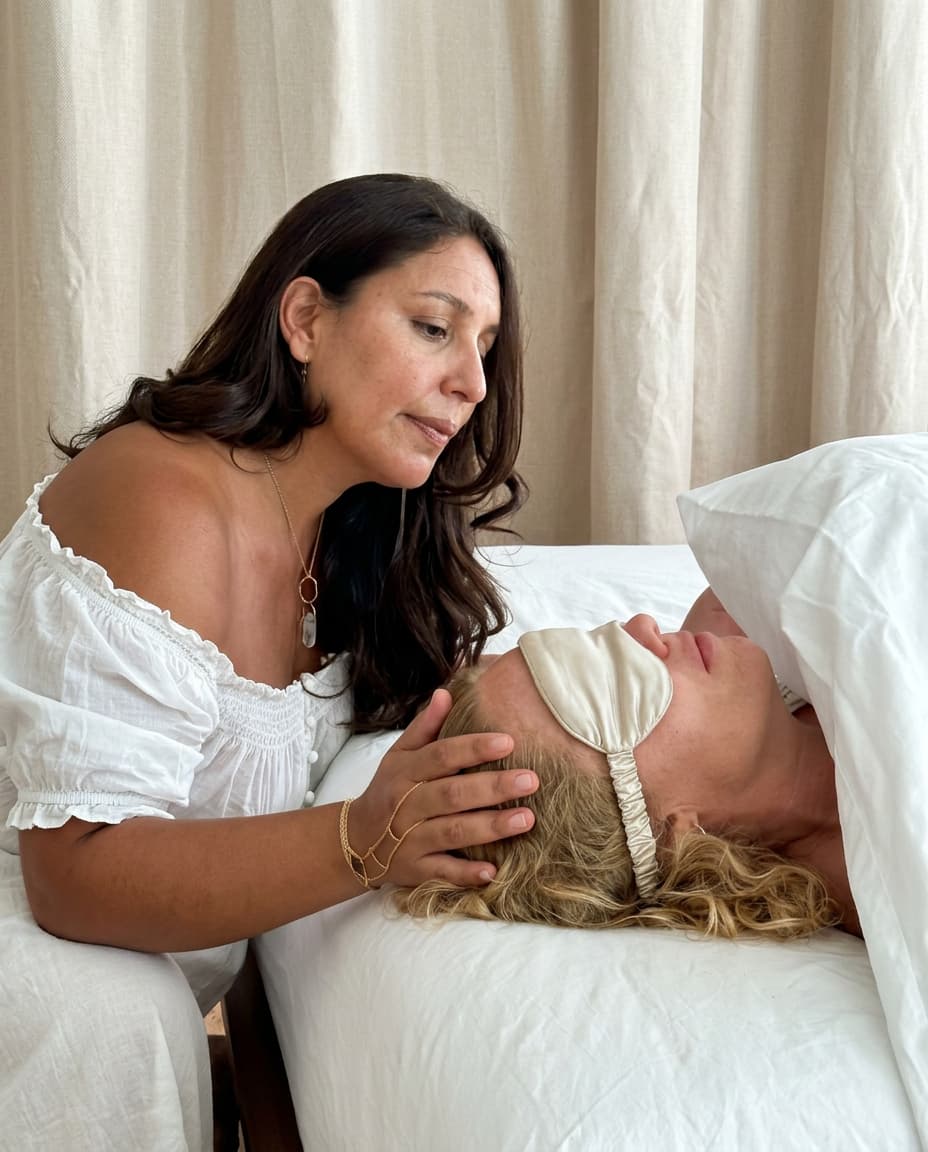
I place my hands on the points where the feeling got stuck. Often the jaw, the throat, the chest or the belly: wherever your body has been holding it. You stay clothed throughout.
You breathe into that point with conscious connected breathwork. The breath softens what has been held tight for years, at a pace your body can take.
What never got to finish starts to come up. Tears, shaking, sound, words you never got to say. Whatever comes is welcome. Often “it hurts” becomes “I hurt”. That is her, finally speaking.
I ask how old she is: the younger you who has been holding this. In a trigger, she takes over and you disappear. Here, you both stay, and this time someone stays with her.
I hold out an open hand. What is in it is usually what she needed and never got: safety, softness, someone who stays. With your breath, you let her take it.
Then I ask you what you love about her. That is the medicine. Not something you become for everyone else, but something you give her first.
Two hours, one-to-one. We close slowly, so what moved has time to settle before you go back into your day.
I am a certified Emotional Release Therapy practitioner, trained by Pat Jackman, who developed the Pat Jackman Method of Emotional Release Therapy and has been guiding this work for more than thirty years. Her directory of practitioners lists about twenty certified practitioners in the United States, and I am one of them.
I also studied Core Energetics with Stuart Black, the body-based lineage this work sits inside. Alongside it I trained in breathwork with Dan Brulé and hold certification under Chris Keener.
And I came to this work through my own body. I know what it is like to understand everything and still carry it. I had to meet my own little girl first. None of that makes me a clinician, and I will not pretend otherwise. It means the hands-on work has a tradition behind it, and I am accountable to how I was taught to hold it.
The idea that emotion lives in the body is older than any of us. Its modern line runs through Wilhelm Reich, the psychoanalyst who first mapped how suppressed feeling becomes muscular “armor”, and through his student Alexander Lowen and John Pierrakos, whose Core Energetics turned that insight into a hands-on practice of pressure, breath, movement, and voice.
That is the river this work drinks from. What I practise is the non-clinical, one-to-one expression of that lineage, trained under practitioners formed in it, and honest about what it is and is not.
For women who have spent years holding everything together, safety is the foundation. This is high-touch private work, held with respect for your pace, privacy, and nervous system capacity.
You stay clothed, in control, and fully respected at all times.
You can pause, slow down, or stop at any moment.
I track your breath, body cues, and emotional pace in real time.
This is private, one-to-one, and held in full confidentiality.
The same phrase is used by practitioners doing genuinely unrelated work, which makes comparing options harder than it should be. Here is the honest map, and where I sit on it.
| talk therapy | Talk therapy helps you understand your story. Emotional Release Therapy lets your body finish it. |
|---|---|
| EMDR | EMDR works through the memory. Emotional Release Therapy works through the body, where the feeling is still held. |
| other somatic work | Somatic work helps you notice it. Emotional Release Therapy lets it come all the way through. |
Especially if you became the strong one, the one who holds everything, and nobody asked what you needed.
You have done the therapy, read the books and understand your story, and your body is still holding it.
In a conflict you suddenly feel small: you hide, you fight, or you go quiet.
You learned early to be fine, to take it, to hold your breath.
Your throat, jaw, chest or belly stay braced, as if something is about to happen.
You are done surviving, and you are ready to let go.
Every response is different. Whatever arises is met with care, consent, and professional containment.
Pressure or tenderness where emotion has been held
Tears, shaking, sound, or words you never got to say
Memories or images surfacing, or nothing you can name at all
Softness, tiredness, or a sense of space afterwards
Common shifts over time
Less reactivity and more choice in intense moments
Clearer boundaries with less guilt
More safety in intimacy and emotional expression
A calmer nervous system and more access to joy
This work uses conscious-connected breathing, which changes how your body handles oxygen and carbon dioxide. For most people that is safe and self-regulating. For some it is not, and I would rather say so plainly here than find out on the day.
None of these is automatically a no. Several are a “tell me more and we will decide together”. Mention it in your enquiry and I will give you a straight answer, including when the honest answer is that this is not the right work for you right now.
It is hands-on bodywork and inner child work, together. When something was too much as a child, the feeling had nowhere to go, so the body held it. In a session I place my hands where it got stuck, you breathe into that place, and the feeling that never got to finish finally does. Then we turn to the younger part of you who has been holding it, and give her what she needed and never got. Sessions are private and one-to-one, and you stay clothed and in control throughout.
Yes. I am certified in the Pat Jackman Method of Emotional Release Therapy, trained by Pat Jackman herself, who developed the method and has been guiding this work for more than thirty years. I completed my certification in July 2026, and I am listed in her directory of practitioners at patjackman.com/ertpractitioners, which names about twenty certified practitioners in the United States.
No. You don't have to tell me the whole story. You don't even have to remember it. Your body and your voice will do that for you. Share as much or as little as you want.
A session lasts two hours. I place my hands on the points where the feeling got stuck, often the jaw, throat, chest or belly, and you breathe into that place with conscious connected breathwork. What never got to finish starts to come up: tears, shaking, sound, words you never got to say. I ask how old she is, the younger you who has been holding it. I hold out an open hand with what she needed and never got, and with your breath you let her take it. Then I ask what you love about her. We close slowly, so what moved has time to settle.
$250 USD for a two-hour session. How many sessions make sense depends on what you are carrying, and we talk about that in our first call. The first call itself is free.
As many as you need to feel complete. It depends on the pattern or the pain you are carrying, so there is no set number. We decide together, one session at a time.
Send me a message through the form on this page or on WhatsApp. I answer every message myself, usually the same day. We begin with a free 30-minute video call on Zoom, so we can meet and you can ask anything before you decide.
Wear comfortable clothing, come without makeup, and do not eat for two hours beforehand. The only other thing to bring is a willingness to let go.
In person, during my time in Franklin, Tennessee and the greater Nashville area, and in Tulum, Mexico. I travel between them in seasons and can share my dates in advance. A session can be held online, but the power of this work comes from moving the feeling through the body with touch, so in person is what I recommend.
I work with everyone. Most of the people I work with are women, and that is where my focus is.
No. This is educational and wellness-oriented work, not psychotherapy, psychiatry, or medical treatment. I am not a licensed clinician and I do not diagnose or treat conditions. It works well alongside therapy, and there are situations where I will tell you that licensed care is what you actually need.
Yes, there are. This work uses conscious connected breathwork, which is not appropriate during pregnancy, or with cardiovascular conditions, epilepsy or seizure disorders, glaucoma or retinal conditions, recent surgery, or a history of psychosis or bipolar disorder. If you are in acute crisis, this is not the right starting point. Tell me what is going on and I will be honest with you about whether to proceed, wait, or start somewhere else.
Emotional Release Therapy is hands-on and works with specific held patterns in the body. Healing Air is a breath-led session for emotional buildup and nervous system reset, with no somatic pressure work. Metanoia is a multi-day private immersion, and Emotional Release Therapy is part of it. If you are not sure which fits, tell me what is happening and I will point you to the right one, including if that is none of them.
No. A massage works on tissue for relaxation and relief, and emotion sometimes surfaces as a side effect. This work runs the other way: the feeling is the point, and touch is how we reach it. You stay clothed, nothing is done without your consent, and the session follows what your body offers rather than a bodywork routine.
Still researching rather than ready to write? Start with the guide: how to release stored emotions from the body (what “stored” actually means, and what you can do on your own before working with anyone).

“If something in you felt seen just now, that’s her. The little one who’s been waiting. You don’t have to hold this alone anymore.”

Tell me a little about what is happening. I answer every message myself, usually the same day, and we will set up a free 30-minute video call on Zoom to meet before you decide anything.
Private. One-to-one. Held with discretion.

